
I began the school year with three guiding questions. First, if reading is developed rather than simply acquired, what do I need to adjust in my teaching to foster that development? Second, can I weave print–sound work across the programme so students build decoding and read-aloud skills while working in a comprehension-based environment? Third, how early can I start an extensive-reading programme that lets students read enough to meet every word in the Spanish 1 core vocabulary at least twenty times and encourage incidental vocabulary growth?
To address these questions I designed a framework that leads beginners toward fluent decoding and independent reading. I presented the framework at CI Reboot 2025 and at Conference in the Cloud 2025. A key step is the use of ultra-beginner readers. These ultra-easy texts—sometimes called baby readers or one-liners—bridge the gap between classroom stories built on familiar language and books that include new words yet stay readable on their own.
What Makes an Ultra-Beginner Reader
Ultra-beginner readers are very short graded books that students can finish in a single sitting. Each title is 250 to 500 words long and uses a controlled vocabulary of roughly 24 to 75 headwords, cognates included. Even a slow reader, moving at 50 words per minute, needs only five to ten minutes to reach the end, so these books are a good fit for the first ten minutes of silent reading.
I call them one-liners because most pages contain just one or two concise sentences, each paired with an illustration that anchors meaning and keeps students engaged. On-page footnotes offer immediate help: sometimes only the new word is glossed, sometimes every word gets a translation, almost like a bilingual text. Everything the reader needs is right there on the page, so they can handle unfamiliar language without reaching for the glossary at the end of the book.
Where to Buy and at What Price
Several independent authors already publish ultra-beginner titles, including Adam Giedd, Mira Canion, Mike Peto, and the team of Jennifer Degenhardt with Theresa Marrama, and I expect all of them will keep adding to the shelf. You can buy printed copies of their books on Amazon or through your favourite CI distributor, but in my opinion paying $10 for a 250- to 500-word book that students finish in ten minutes is not the best use of an extensive-reading budget. One $10 Level 1 reader or CI novel (over 2 500 words) gives far more teaching mileage: students can read it over several days, the narrative is more meaningful, and you can teach from it.
What then? Each author sells annual digital licences. Adam Giedd’s Confidence Readers Premium costs $97 per year and gives you unlimited printable PDFs, slide decks, audio recordings, videos, worksheets, illustrations, and every new book the moment it is released. Mira Canion’s Arlo collection costs $19 per title. Mike Peto offers access for $39.99 per year to short comics and stories at various levels; each illustrated panel carries just one line of text, so they work much like one-liners. I couldn’t gain access to Jennifer Degenhardt and Theresa Marrama’s Digilangua platform, but I did pick up one of their mini-books in print, and it earned a spot in my physical library.
How I Put One-Liners to Work
Even though these little books cannot sustain an extensive-reading programme, because there are too few titles, each one is too short, and they cover only a small slice of my Level 1 core vocabulary, I still use them as a springboard. I subscribed to most of these platforms (or bought the books in print when digital access was not possible) so I could test them myself. Then I built an online reading library with ten ultra-beginner readers I liked, totalling about 3 000 words. I set it up in Canva and shared it with my classes. When students click a cover, they go straight to the place where the book lives. Some students have already read all ten, while others will need about three weeks. After finishing a title they log it in their Reading Marathon course and add a short review.

Curiosa: Try an Ultra-Beginner Reader Today!
Teachers already know me for writing some of the easiest Level 1 books on the market, but I had never released an ultra-beginner title. Since 2023 I have posted #Fotocuentos on Instagram—short, picture-rich stories such as La princesa y el monstruo de la torre, El vigilante, El perro y el biftec and El niño y el océano. While building my online extensive-reading library and linking to other one-liners, I realised these stories were perfect for the format. I took the first #Fotocuento, adapted it and Curiosa was born. I am delighted to share it with you.
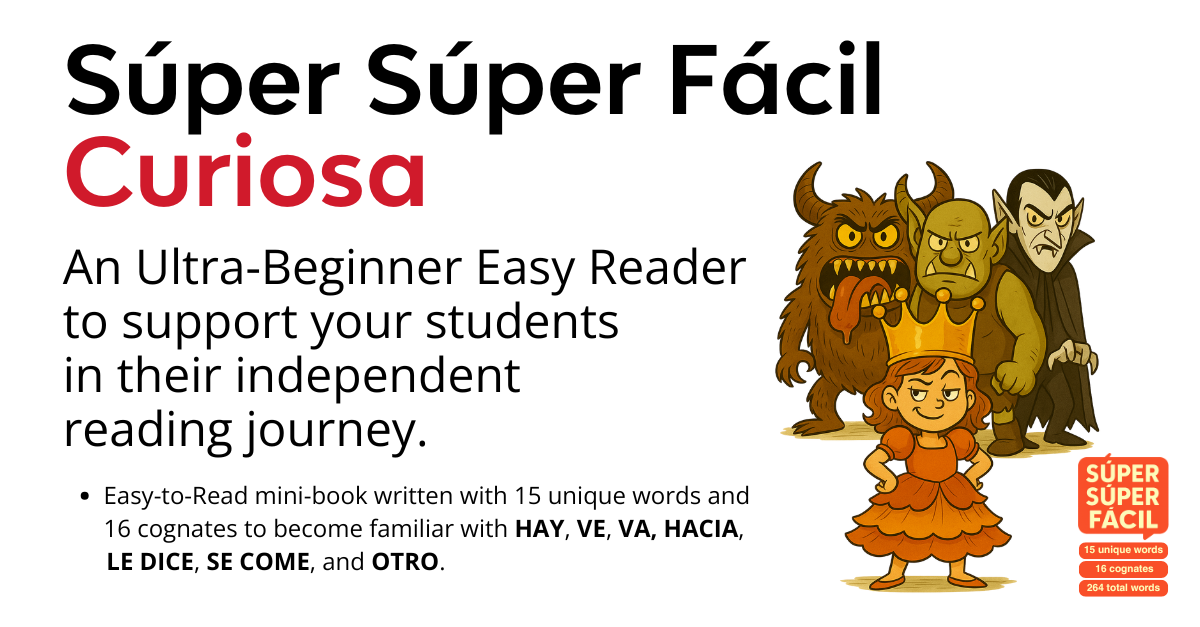
Curiosa (Super Súper Fáciles #1)

A princess with more curiosity than caution ignores three frantic guards who insist a monster, an ogre and a vampire lurk in a lonely tower. She goes in anyway … and meets someone far smaller—yet far cheekier—inside. The twist ending leaves newcomers laughing and asking for “¡Otra!”
- Ultra-Beginner Spanish Reader written with just 15 unique words plus 16 cognates
- One or two short sentences per full-colour page, each translated in footnotes for instant support
- High-frequency structures: hay, ve, va, hacia, le dice, se come, otro
- Free download package: illustrated PDF, read-aloud video, non-illustrated text for re-reads, and Gimkit sets to practise the vocabulary.
Comments
One response to “Super Super Easy: Meet Curiosa, My First Ultra-Beginner Reader”
[…] these resources, please join my mailing list. Once a month you will receive a concise email with an Super Super Easy. It is a simple way for us to stay connected and for me to thank you for your support. ♥I’m not […]