
When I’m reading with beginners or students with reading difficulties, I try to create what I call a “single-page reading experience.” Students should have as much support as possible right where they are reading, to never have to leave the page to check a glossary.
In my books, I already use controlled vocabulary, introduced gradually chapter after chapter, images, and support built right into the side notes to help students stay with the text. Everything they need to understand the text is in front of them, on the same page.
Last year I worked with a student with severe reading difficulties who made me realise that even this was not always enough. The experience led me to develop a reading intervention for her to make meaning of the reading and access it without becoming anxious.
She was several years behind her reading age and found reading difficult even in her mother tongue. She struggled to access the meaning of words in the text, and wouldn’t recognise a word even after meeting it many times, even when we’d established its meaning together before, on the same page, the same paragraph, sometimes just a few lines earlier. She could not always recognise a word, connect it with meaning, and keep reading the sentence, all at once. And she couldn’t use the glossary either.
The problem with glossaries at the back of the book
Using the glossary was too confusing and slow for her: too many words, too many similar shapes, and no way to hold her place while she searched.
Think about what a glossary actually asks of a reader: hold a word in your head, flip to an alphabetical list, scan down a column of text, find the entry, read the definition, then carry that meaning back to the sentence. Most readers manage this without trouble. For her, it was five separate tasks stacked on top of the one she was already struggling with, and by the third step she’d usually lost the thread.
Words with similar letters made it worse. She needed to look closely, in isolation, considering each letter and the overall shape of the word, which meant that by the time she reached the glossary, she’d often forgotten the very word she was looking for.
Visual glossaries
The less a student understands, the more anxious they become, and the more anxious they become, the less they can understand.
Reading anxiety and comprehension difficulties feed each other. We can put a reading intervention in place to stop that cycle before it turns into extreme reading anxiety and a feeling of failure. This is where visual glossaries and glossary cards came in.
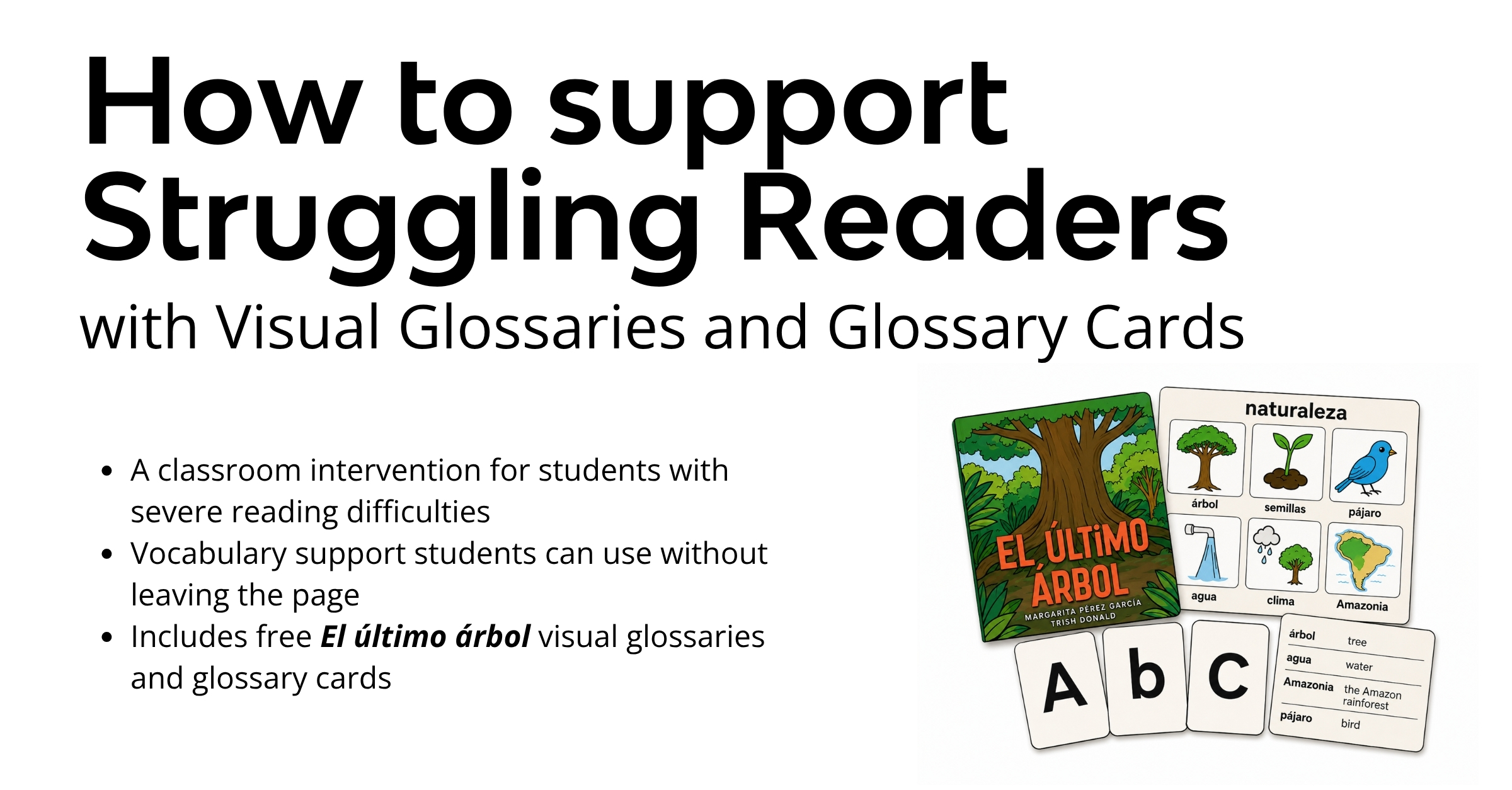
The idea of visual glossaries isn’t new, but I recycled it here using augmented and alternative communication (AAC) boards. The boards act as an interface: students, or I, point to a word, and the image sitting alongside it does the work of reinforcing meaning. I display these while teaching the book, and they double up nicely as a communication mat. I print them for the whole class, whether a student has an identified need or not, so they become a shared reference throughout the reading of the book. This matters because the support becomes part of the reading environment, and no student is singled out for using one.
I organise mine semantically rather than alphabetically, because meaning clusters help a reader hold vocabulary in mind. Each page has 10 words, so across a set there are be 50 words in total, all of which the students have already met during the pre-reading activities of the book.
For El último árbol, I created five:
- the nature and the rainforest under threat
- the problem the book exposes: deforestation, pollution, climate change,
- the journey of the blue bird across the world, its return to the Amazon rainforest with the other birds and seeds
- the human effort to replant it
- and numbers and colours used in the book.


You can download the visual glossaries I made for El último árbol here.
The images themselves follow AAC pictogram principles. They either come directly from the ARASAAC symbols database, which follows strict rules for clarity: one clear referent per image, consistent line weight, no decorative clutter competing with meaning. Or I generate them, combining AAC principles with easy-read image guidelines: high contrast, uncluttered backgrounds, literal rather than metaphorical representation, so that nothing between the word and its meaning requires interpretation. The result is that a student can find meaning at a glance instead of having to search for it. Well, except for the word ESPERANZA. How do you depict that?
Glossary cards
We were reading El último árbol, the first long book to open my students free voluntary reading program. My student was struggling with the word HACIA, and once she reached the glossary she’d confuse it with HAY. So I made a small, improvised glossary out of loose pieces of paper, right there on the table in front of her. I wrote HACIA, then HAY, with their meanings, and we looked at them together: first letter, second, third, and the different overall shape of each word. Then I turned the pieces of paper face down and hid them under a card marked H.
When she saw HACIA again in the text, she didn’t need to go to the glossary at the back of the book or ask for my help. She looked at the first letter, went to the H pile, turned over the cards, compared the words, and found the one she needed. She could hold the card in her hand and return to the sentence, reading it again until it finally made sense.
That’s how glossary cards were born. They’re such a useful tool precisely because they limit what a student has to hold in view at once: the cards sit in a pile or spread across the table, and students only ever turn over the ones they need, rather than confronting the entire vocabulary of the book in one long list. It keeps the cognitive load proportional to the task in front of them.
Here are the glossary cards for El último árbol, feel free to download them as PDF or grab a copy from Canva and adapt them for your own students.

The cards are very simple. On one side, students see only the first letter. On the other side, they see the words that belong to or start with that letter, with the meaning presented in a table so a student can move their finger and get to the word. Notice how the definitions are provided are the appropriate reading age. The cards are placed face down by first letter, so if a student sees a word beginning with H, they go to the H pile. They don’t search the whole glossary, just turn the card in front of them, right by the page.
What to Do When Students Are Anxious About Reading
I’m speaking at a the Back-to-School World Language Teacher Summit 2026 on reading anxiety this year, where I’ll be presenting on how anxiety impacts struggling readers’ relationship with a page, and what we as teachers can build to support them. Click here to get your free ticket and you’ll also get the El último árbol teaching guide for free.
With teacher’s love,
Margarita x
Leave a Reply