
I spent last week at the 7th Extensive Reading World Congress in Sapporo, Hokkaido. Organized by the Extensive Reading Foundation, the event brought together about 400 educators from around the world at Hokusei Gakuen University. It was not only my first time at the congress but also my first time in Japan, which made the whole experience even more exciting.
On Sunday, during the poster session, I had the pleasure of meeting two teachers from Mongolia, Tamir Myagmarsuren and Solongo Purevsuren, from the 1st School of Khanbogd in Southgobi province, who showed me a simple but effective way to keep students reading over the holidays and engaging more deeply with texts through one-pager visual summaries.


Read 5 books over the break
Tamir and Solongo run their Extensive Reading Program through the Xreading platform. Over the summer break, they asked their students to read five books and create a one-pager for each one, a single-page visual summary of the reading. Their aim was to build independent reading habits, keep students accountable, and encourage deeper engagement with the texts. In total, 476 students from grades 6–12 took part, reading more than 700 books altogether.
One-Pager Visual Summaries
One-pagers are a well-known post-reading activity, essentially a visual summary on a single page. The idea is not new, and teachers can find plenty of examples online: here and here. What stood out to me in this project was the clarity of the categories and the way students were guided through them, making connections between the books they read and other texts and today’s events. In this way, it goes a little beyond the Smahdoodle™ by being more structured, while still leaving room for creativity and student choice.
Visual Summaries Directions
A one-pager is a way to show what you understood from a book on a single page. You use words, drawings, and symbols to share the most important ideas in a creative and clear way.
For this activity, include the following:
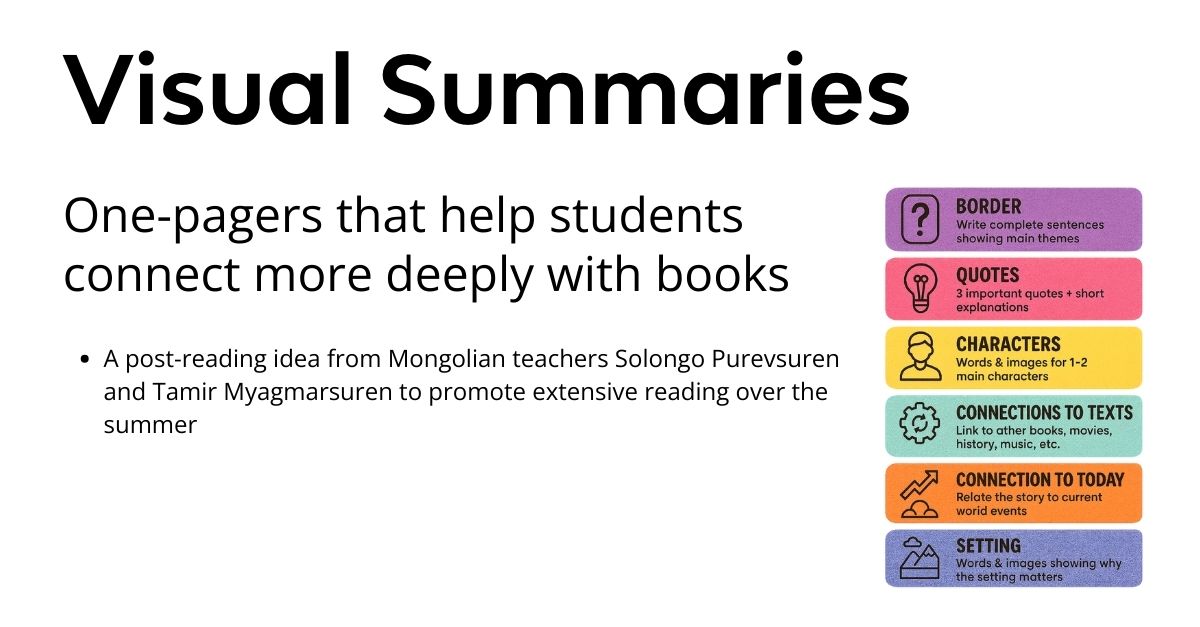
- Border: Add complete sentences and images around the edge that show the main themes. The border frames the page visually and highlights the big ideas.
- Quotes: Choose three important quotes and write a short explanation for each one.
- Characters: Illustrate one or two main characters with words and/or images to show their traits and relationships.
- Connections to Texts: Link this book to another story, movie, song, or historical event, and explain why you made the connection.
- Connection to Today: Show how the story connects to something happening in the world now. This makes reading feel relevant and alive.
- Setting: Use words and images to explain why the setting matters and how time and place shape what happens.
You can also add any other drawings, designs, or words that help show your response to the book.

Making connections Matters
Independent reading is hard to sustain during holidays, but making connections gives it purpose. When students link what they read to their own lives and to the world around them, reading becomes more meaningful. With the right support, those connections help them reflect deeply and build habits that last.
Visual Summaries Examples
Here are a few examples of students’ work that Tamir and Solongo’ shared with me during the conference.


Leave a Reply